Akademi Crypto
A cryptocurrency and blockchain education platform featuring structured courses, video modules, learning progress, certificates, payments, and centralized administration.
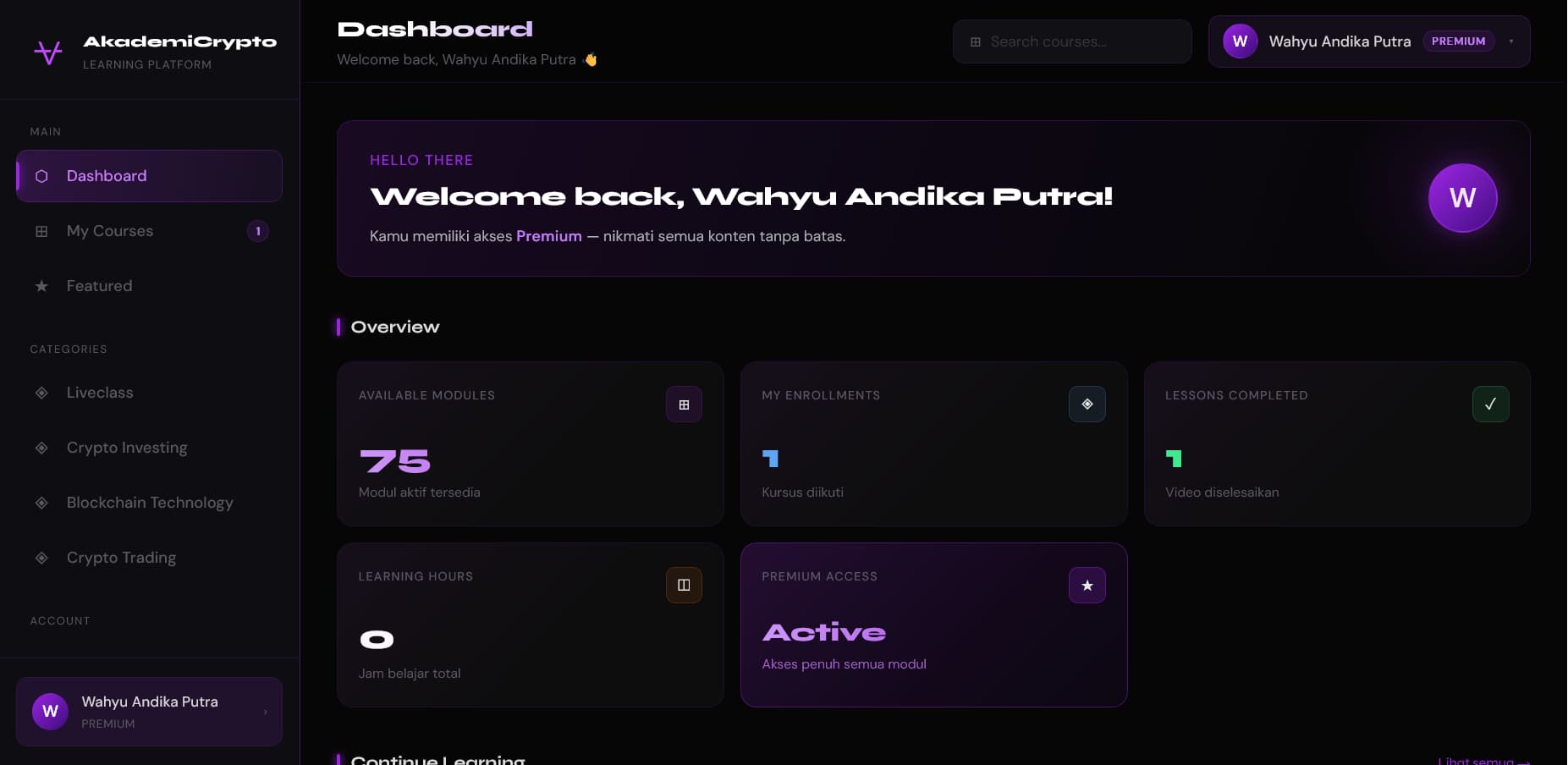
Building a Structured Cryptocurrency Education Platform
Project Overview
- Akademi Crypto is an online education and research platform focused on cryptocurrency, blockchain technology, digital assets, market analysis, trading, and portfolio management.
The platform was designed to provide a structured learning environment where users can access educational modules, study video based materials, monitor their learning progress, obtain certificates, manage their profiles, and interact with supporting platform services.
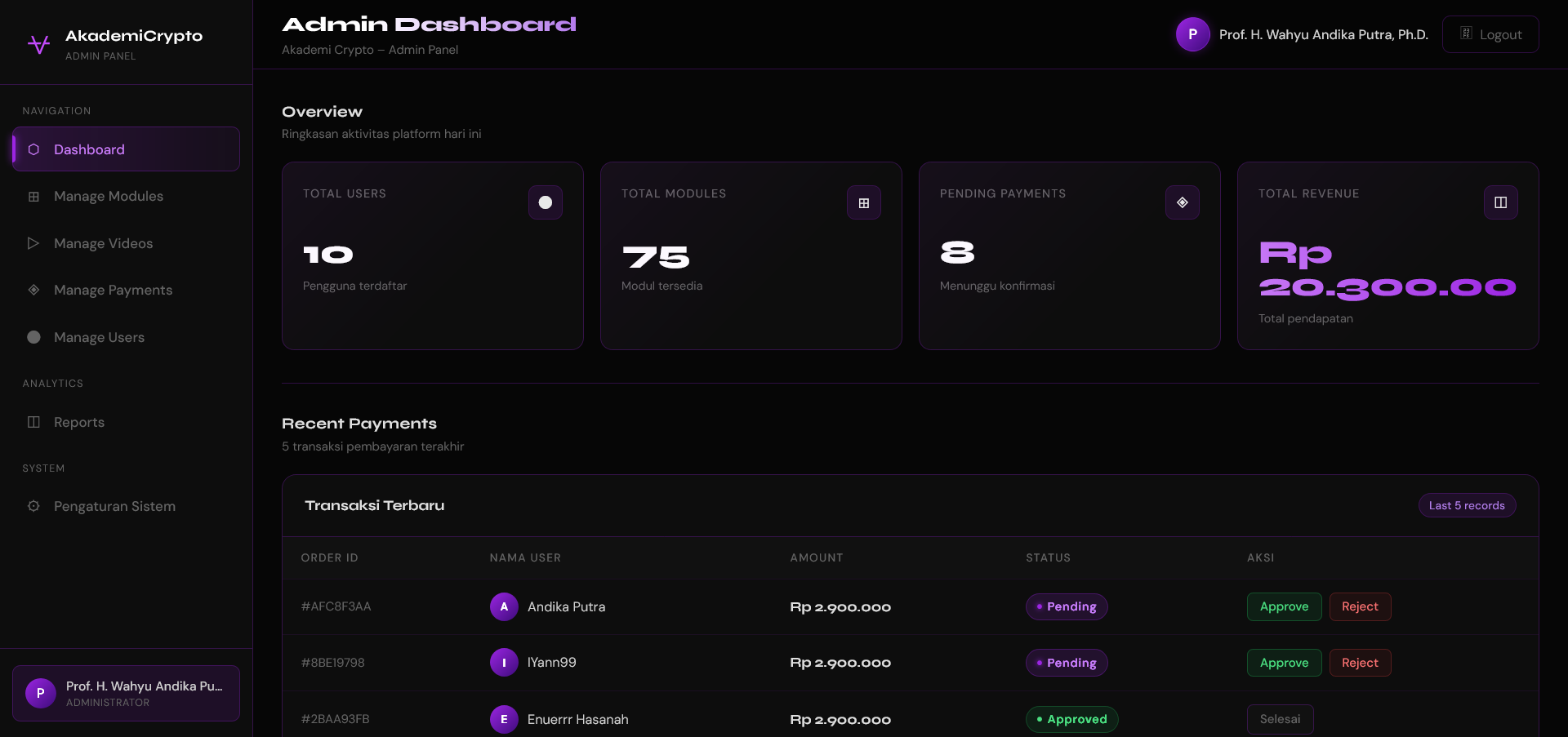
The system combines an educational content platform with a dedicated administrative management layer. This architecture allows administrators to manage users, educational modules, video content, payments, support requests, platform settings, and operational reports through centralized management interfaces.
The project was developed using Express.js as the backend framework and MongoDB as the primary database, with a server rendered interface powered by EJS.
Project Objective
The primary objective was to create a centralized digital learning platform for individuals seeking structured knowledge about cryptocurrency and blockchain technology.
Instead of presenting educational materials as isolated articles or videos, the platform organizes learning content into structured modules and courses. This approach provides users with a clearer progression from foundational concepts to more advanced subjects.
The platform was also designed to support the operational requirements of an online learning business. These requirements include authentication, course enrollment, payment processing workflows, learning progress tracking, certificate management, support requests, administrative reporting, and user account management.
The resulting architecture provides both the learner experience and the operational infrastructure required to manage the platform from the administrative side.
Learning Experience
The user facing platform is structured around a dedicated learning environment that allows users to discover available content, enroll in courses, access individual course materials, and monitor their progress.
The application includes dedicated interfaces for the dashboard, featured content, enrolled courses, course details, user profiles, account settings, certificates, and certificate verification.
This structure creates a complete learning lifecycle.
A user can register for an account, access available educational content, study modules and video materials, maintain learning progress, complete the required learning process, and access certificate related functionality through the same platform.
Educational Modules
The platform provides structured educational modules covering topics related to cryptocurrency, blockchain technology, digital assets, market analysis, trading, financial literacy, and portfolio management.
Educational content is organized into reusable module and video entities, allowing the platform to maintain a consistent content structure as the learning library expands.
The underlying data model includes dedicated entities for modules, videos, enrollments, and user module progress. This allows learning activity to be represented independently from the presentation layer.
This separation is important for an LMS because educational content must remain manageable even as the number of courses, modules, and learners increases.
Course and Content Management
Course delivery is supported through dedicated interfaces for course discovery, course detail pages, featured content, and enrolled courses.
Administrators can manage educational modules and video content through dedicated management interfaces.
The content architecture separates course information from individual video materials and learner progress. This makes it possible to create a more structured relationship between educational content and user activity.
The platform therefore functions as more than a static educational website. It operates as a content driven learning management system with persistent learner state.
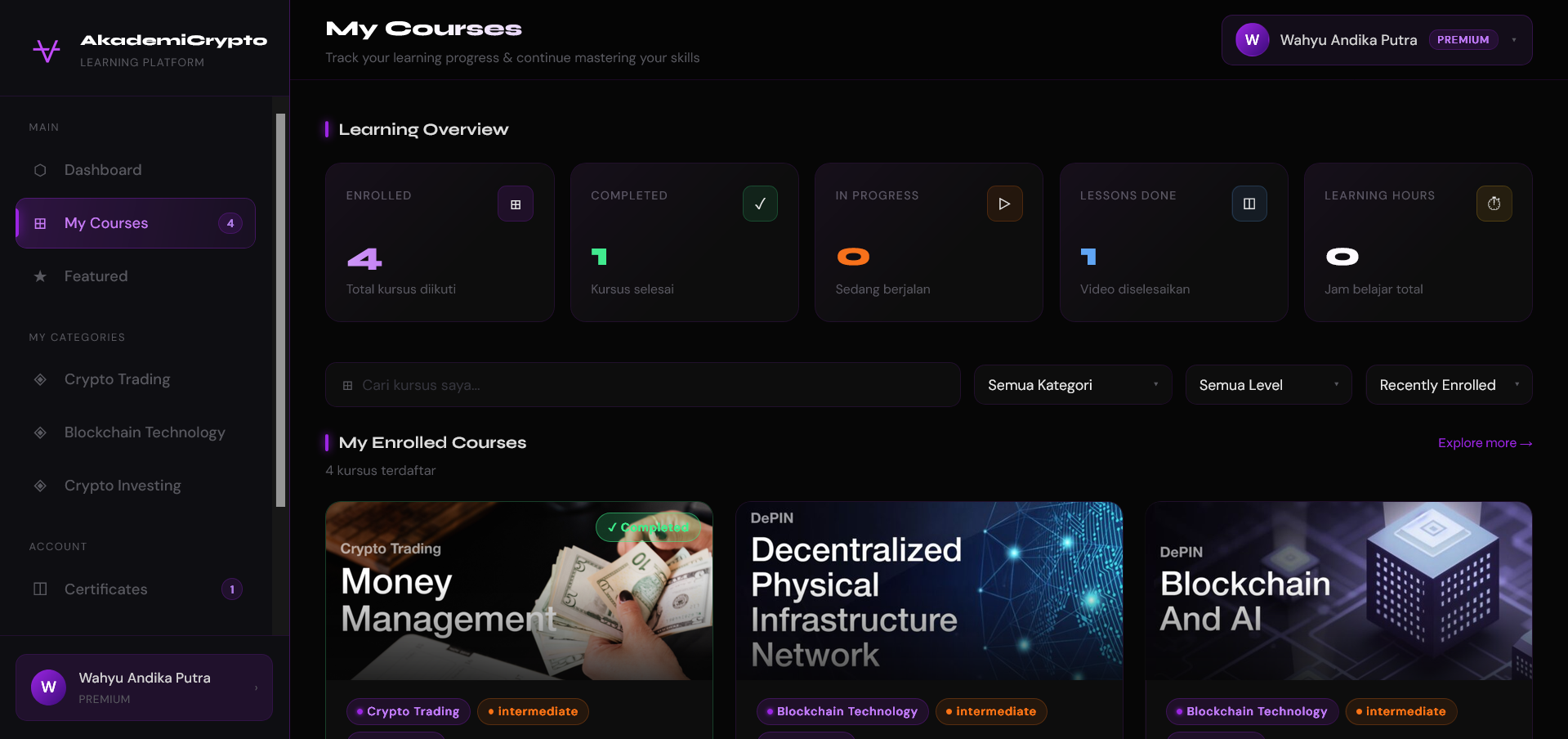
User Dashboard
The user dashboard acts as the primary entry point for authenticated learners.
It provides access to the user's learning environment and connects the major areas of the platform, including enrolled courses, educational progress, certificates, account information, and other user specific features.
A dedicated dashboard architecture allows the user experience to remain focused on personalized content rather than exposing administrative functionality to standard learners.
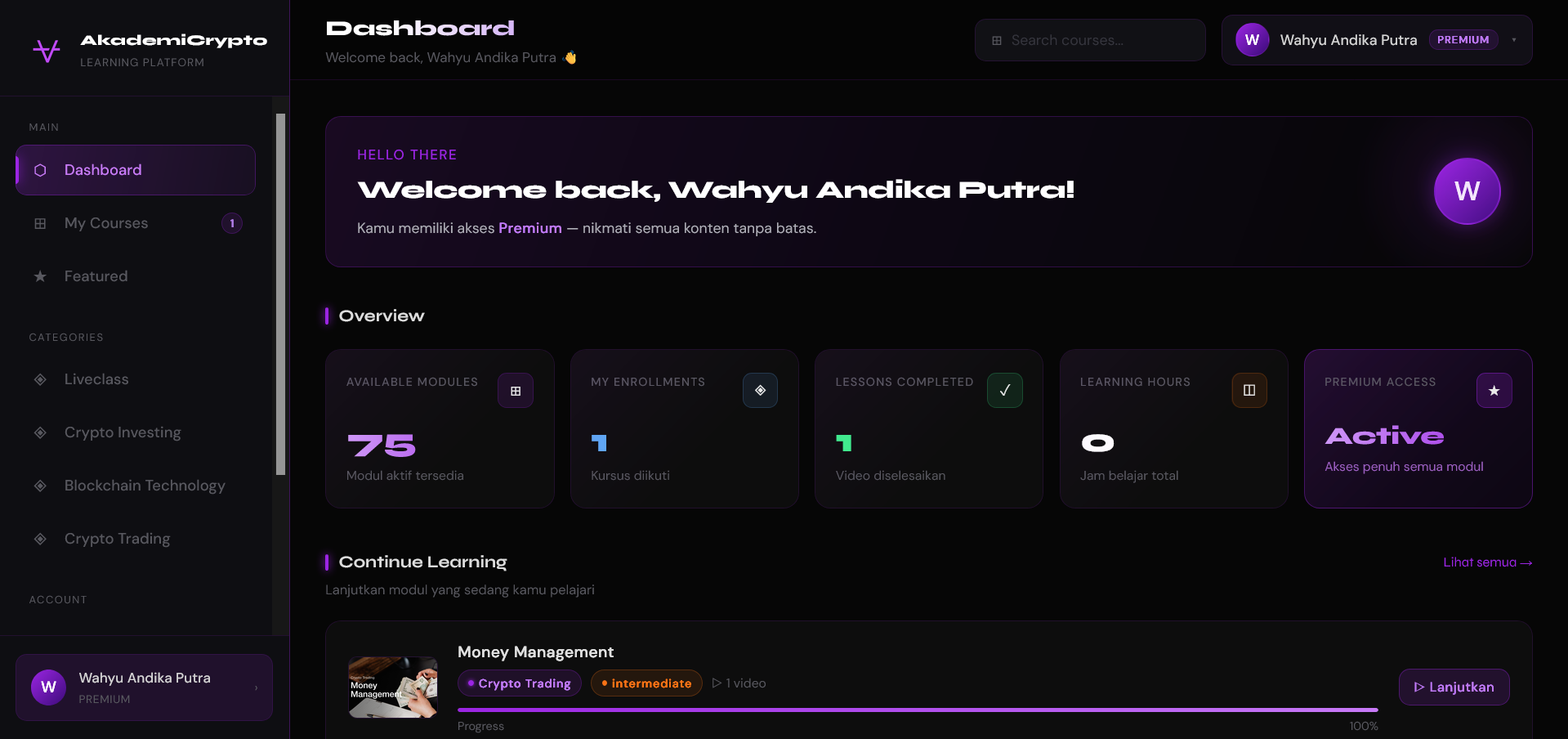
Learning Progress Tracking
A dedicated UserModuleProgress data model is used to represent the relationship between learners and their educational progress.
This architecture allows learning activity to be stored independently from the educational content itself.
The separation provides a more scalable foundation for tracking which modules have been accessed or completed by individual users.
From a product perspective, progress tracking is essential because it transforms the platform from a simple content repository into an actual learning system.
Authentication and User Management
The platform includes dedicated authentication interfaces for user registration and login.
User accounts are represented through a dedicated User model and are connected to several additional entities that support enrollment, progress tracking, certificates, preferences, sessions, and operational logging.
This architecture enables the platform to maintain a persistent identity for each learner while keeping account related functionality separate from core educational content.
The administrative interface also provides dedicated user management and user detail functionality.
Certificate System
Certification is implemented as
an independent functional area within the platform.
The data architecture includes a dedicated Certificate model, while the user interface provides access to certificate records and certificate verification functionality.
This allows the platform to support a complete relationship between a learner, their educational activity, and the resulting certification record.
Certificate verification is particularly valuable for an educational platform because it provides a mechanism for validating issued credentials independently from the learner dashboard.
Payment Workflow
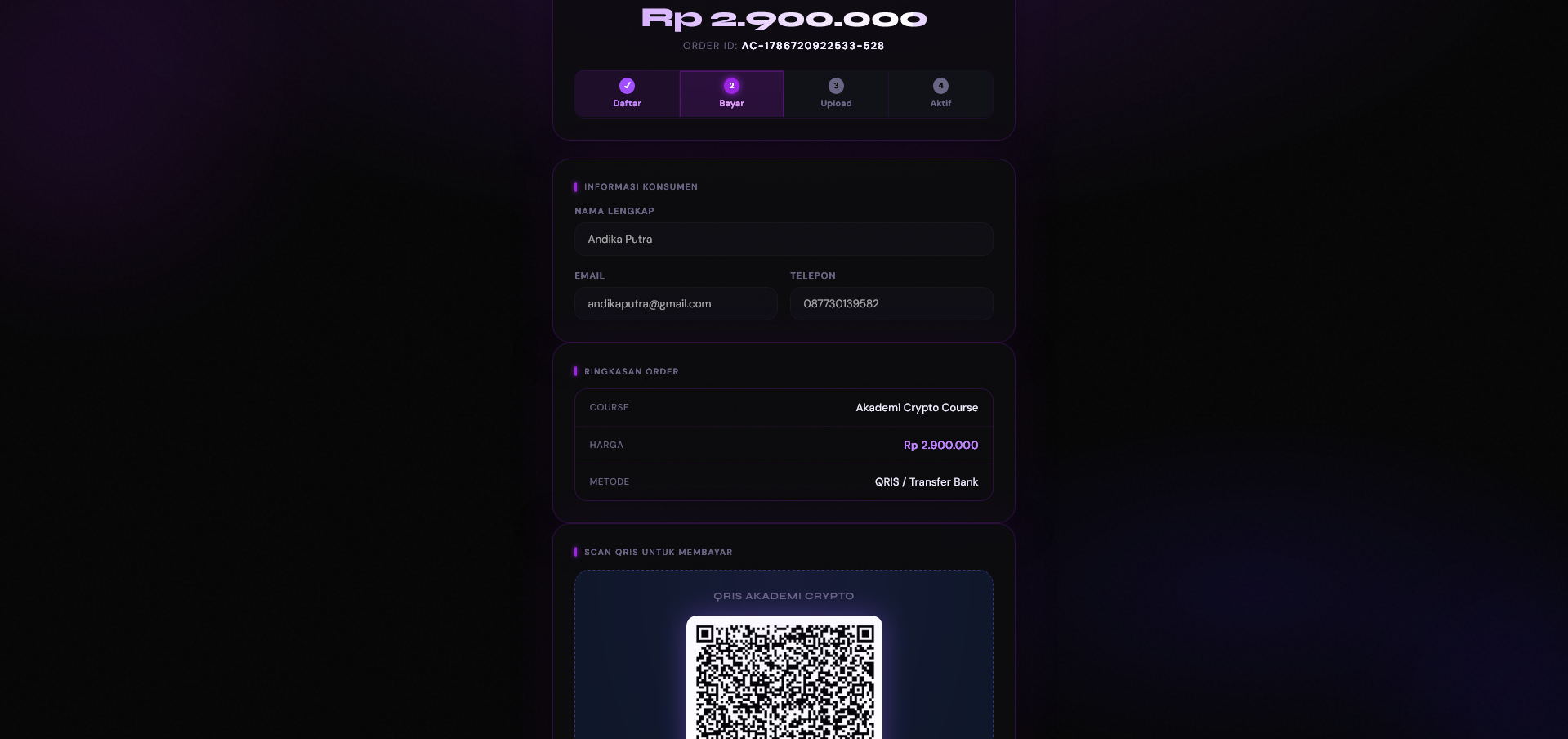
The platform contains a dedicated payment subsystem with separate payment controllers, routes, models, and views.
The payment interface includes payment, payment status, payment success, and retry states.
This architecture separates payment related state from the main learning system while maintaining the necessary relationship between user enrollment and payment activity.
The result is a clearer transaction lifecycle that can accommodate payment initiation, status handling, successful completion, and retry scenarios.
Support System
A dedicated support subsystem is included to provide users with a structured channel for requesting assistance.
The platform includes a support ticket model, a support controller layer, and dedicated user facing support interfaces.
From an operational perspective, this creates a clear separation between educational functionality and customer support workflows.
Support interactions can therefore be managed as structured records rather than relying entirely on external communication channels.
Administrative Architecture
The administrative system provides centralized control over the major operational components of the platform.
- Dedicated administrative interfaces include:
- User management
- Module management
- Video management
- Payment management
- Support ticket management
- Reports
- User details
- User editing
- System settings
- Administrative dashboard functionality
This structure allows platform operators to manage the learning ecosystem without modifying application code for routine content and operational tasks.
Backend Architecture
The backend is built with Express.js and follows a modular separation between routes, controllers, middleware, models, views, and configuration.
The application contains dedicated route groups for authentication, users, administrators, and payments.
Controllers handle application level logic for administrative operations, payment workflows, and user functionality.
Middleware is used for security related processing and file upload handling.
The application also includes a dedicated configuration module for Cloudinary integration, supporting a centralized approach to external media handling.
This separation creates a clearer backend architecture and makes individual application responsibilities easier to maintain.
Database Architecture
MongoDB is used as the primary database technology.
The data layer is divided into specialized models representing the core entities of the platform.
These include:
- User
- Module
- Video
- Enrollment
- UserModuleProgress
- Certificate
- Payment
- DeviceSession
- LoginAttempt
- IPBlacklist
- Settings
- SupportTicket
- SystemLog
- UserLog
- UserPreference
This model structure reflects a domain oriented approach to application data.
Educational content, user identity, payments, security events, operational logs, preferences, and support workflows are represented as separate concerns rather than being compressed into a single database structure.
Security Architecture
Security related functionality is represented explicitly within the backend architecture.
The project includes dedicated security middleware together with data models for device sessions, login attempts, IP blacklisting, system logs, and user logs.
This provides a foundation for monitoring authentication activity, recording operational events, and implementing additional access control mechanisms.
The presence of dedicated security and logging entities also creates a more appropriate architecture for a platform handling authenticated users, payments, and educational credentials.
Security is therefore treated as part of the application architecture rather than an isolated feature added at the end of development.
File and Media Management
The application includes dedicated upload middleware and Cloudinary configuration.
This architecture separates media processing from the main application logic and provides a centralized mechanism for handling uploaded assets.
Educational platforms typically depend heavily on images, videos, certificates, and other media resources. Centralizing media handling therefore helps maintain a cleaner application structure and simplifies future content expansion.
Frontend Rendering
The application uses EJS templates for server side rendering.
The view structure is organized according to functional domains including administration, authentication, payment processing, support, and user learning functionality.
This creates a clear relationship between the backend route architecture and the presentation layer.
The separation also makes individual interface areas easier to maintain because administrative pages are isolated from learner facing pages.
Project Structure
The project is organized around a modular backend and server rendered presentation architecture.
The main application layers include the API entry point, configuration, controllers, middleware, database models, routes, public assets, and EJS views.
The structure follows a clear separation of responsibilities across the system.
Authentication functionality is isolated from payment functionality.
Administrative functionality is separated from user functionality.
Educational content is represented through dedicated models and views.
Security functionality is implemented through middleware and supporting data models.
This organization improves maintainability and provides a foundation for future feature development.
Engineering Considerations
One of the most important engineering decisions in the project was to separate core business domains instead of implementing the application as a monolithic collection of route handlers and templates.
The separation between users, education, payments, certificates, support, security, and administration allows individual areas of the system to evolve with less dependency on unrelated functionality.
For example, educational content can be expanded without restructuring the authentication layer, while payment workflows can evolve without changing the fundamental course data model.
This type of separation becomes increasingly valuable as an education platform grows in both content volume and user activity.
Technical Outcome
The completed Akademi Crypto platform demonstrates the implementation of a structured learning management system using Express.js, MongoDB, and EJS.
The system combines educational content delivery, user authentication, course enrollment, progress tracking, certificate management, payment workflows, support functionality, administrative operations, security controls, logging, and media management within a unified architecture.
The application therefore represents a complete web based education platform rather than a simple informational website.
SEO and Digital Education Platform Positioning
From an SEO perspective, the platform can be positioned around high intent search categories related to cryptocurrency education, blockchain learning, digital asset education, trading education, crypto courses, Web3 education, and portfolio management.
The structured relationship between courses, modules, videos, user learning activity, and certificate functionality also creates a strong information architecture for expanding educational content over time.
Individual educational topics can be developed into focused content pages and course experiences, allowing the platform to build topical authority around cryptocurrency and blockchain education.
A clear hierarchy between platform pages, course content, educational modules, and supporting information is particularly important for search visibility because it helps both users and search engines understand the relationship between different areas of the platform.
Final Perspective
Akademi Crypto was developed as a structured digital learning ecosystem for cryptocurrency and blockchain education.
The project combines a learner focused interface with an administrative management platform and a backend architecture designed around clearly separated business domains.
Its technical foundation demonstrates practical implementation of Express.js, MongoDB, EJS, authentication, database modeling, course management, payment workflows, progress tracking, certification, support systems, security middleware, logging, and media management.
The central architectural objective was to create a system that could support real educational operations rather than simply present educational information.
By combining structured learning content with persistent user state, administrative controls, operational workflows, and supporting infrastructure, Akademi Crypto provides a scalable foundation for a modern cryptocurrency education platform.